
Fact-Checking the New York Times on Venezuela
Venezuela is, Without a Doubt, a Socialist Country

In their coverage of Venezuela’s election, the New York Times states that “in recent years, the socialist model has given way to brutal capitalism”. In a 2020 article (thanks to Jeffrey P. Clemens on X for alerting me to this in his post), they state that Maduro has "made peace with the private sector and let it loose" and described Venezuela as a "free market economy" due to "drastic economic liberalization."
The traditional definition of socialism is state ownership of the economy, especially for those concerned about F. A. Hayek’s The Road to Serfdom argues about the incompatibility between socialism and political freedom (source).
Thankfully, we have an independent dataset to check the New York Times. The Varieties of Democracy Institute has country-year data on state ownership of the economy, crafted by experts from around the globe, going all the way back to 1789. Here is the data from 1990 in Venezuela, where 0 = complete state ownership or control of the economy and 4 = complete private ownership of the economy:
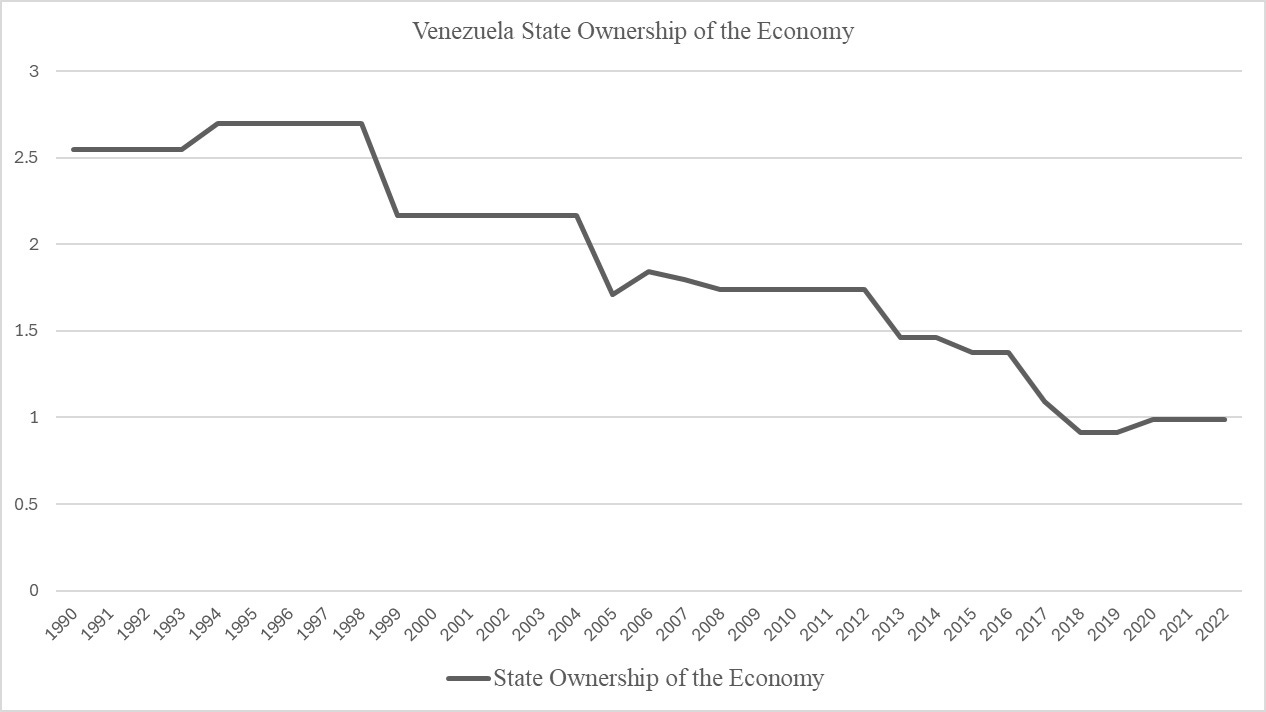
A few embarrassing empirical facts for the New York Times:
By the traditional definition of socialism, state ownership of the economy, Venezuela is, without question, socialist. Only extreme bias or ignorance could lead one to refer to this as “capitalist” in any sense.
Since Maduro took office in 2013, the state has nearly doubled its state ownership of the economy. Its score moved slightly towards private ownership from 2019 to 2020, but it only moved .072 on a 4-point scale. There has been no substantial liberalization under Maduro.
While it may be politically convenient for the New York Times to attempt to blame the economic and democratic collapse of Venezuela on capitalism, the facts speak for themselves.